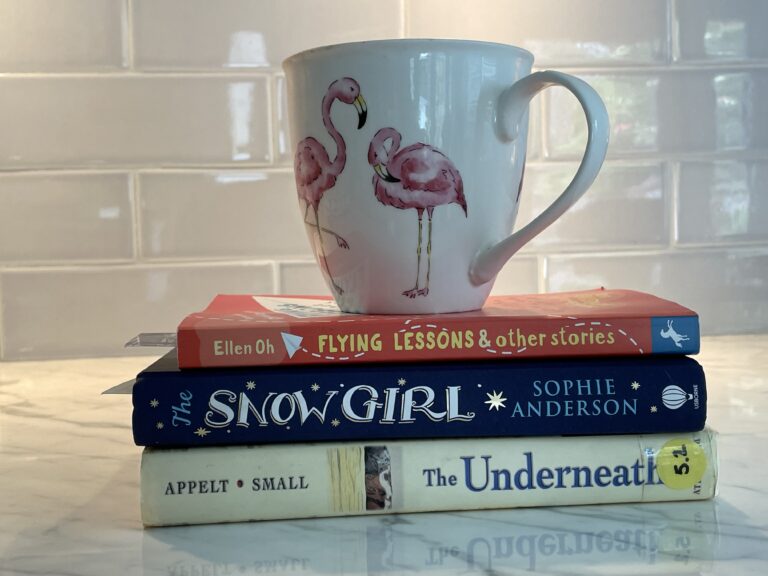
Lately, a lot of the blog posts I read are about details in writing and how to show not tell.
It’s kind of amusing how one post will be about something and then other bloggers seem to say, “Oh, I should write about that, too.” (There are no new ideas under the sun.)
And so, here I am saying, “oh, I should write about that, too.”
If you say you’re an artist, I would expect to come into your space and see a studio or at least a sunny corner with an easel and a work-in-progress, maybe a live model posing, tubes of paint, palettes of color, maybe a stack of blank canvasses, your work on the walls, some books of artists you admire. In my head, your studio would be a bit disheveled.
But if, instead, I come in and see none of that, are you still an artist?
If I’m writing about an artist, I’m going to show that paraphernalia, because telling my readers you’re an artist doesn’t make you one.

Readers need proof that you are what I say you are.
They need a visual of your space so they can imagine you there.
What do you think the space of someone who writes looks like?
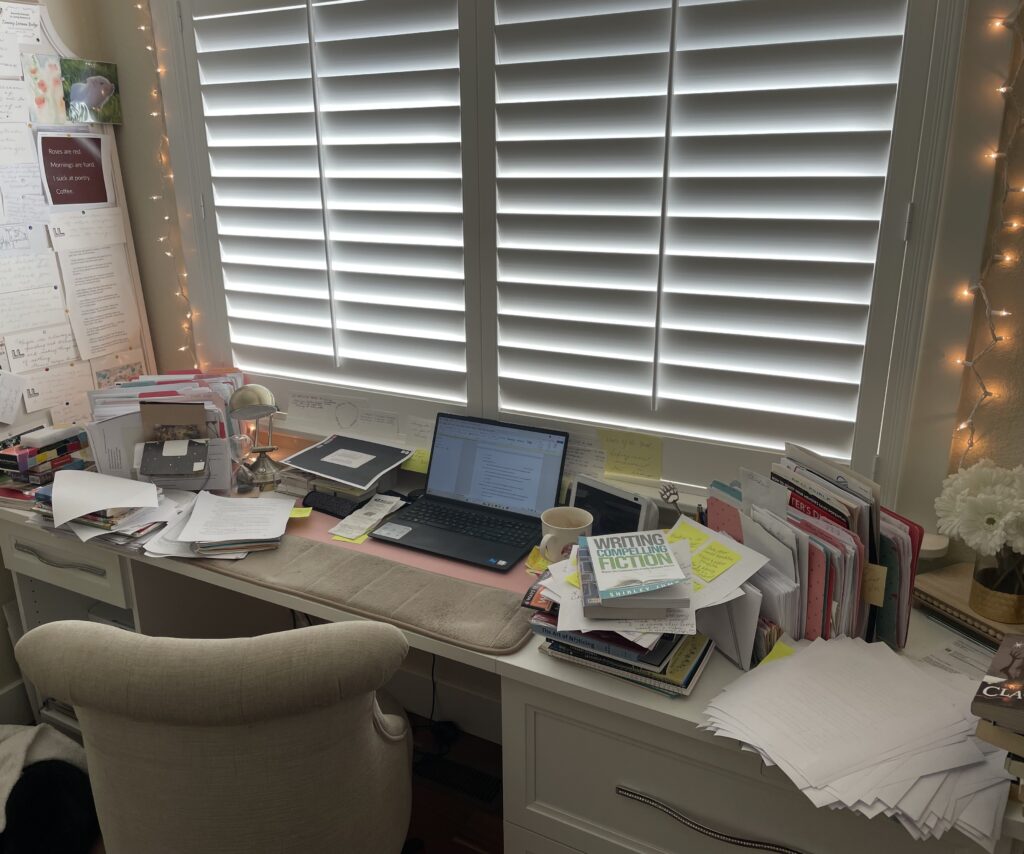
This picture is my office.
It’s not Instagram, that’s for sure.
I’m in the middle of editing and trying to keep up on reading and, well, that’s what that looks like.
If I had nothing on my desk but a laptop and a coffee cup, you would be allowed to be skeptical that I do any real writing.
Where are the reference books, the mentor novels, the diversionary novels, the rough drafts, the unfiled other paperwork from life, the note scraps and multiple notebooks?
Those are details you could expect in a description of a writer’s space.
So, in your writing projects, show the details the reader needs.
Then you can enhance the scene and story by adding something unexpected or taking away some detail that a reader would expect to see.
Why is there a pantry full of coffee beans when no one drinks coffee?
Why does the mother keep just one door closed all the time?
Why is the chandelier pulled off the ceiling in the dining room?
Why is there an empty aquarium sitting in the living room?
If you aren’t a writer, make TV watching and reading more fun by noticing what the camera or author is showing that should or shouldn’t be there.
Done correctly, detail can add tension through curiosity.
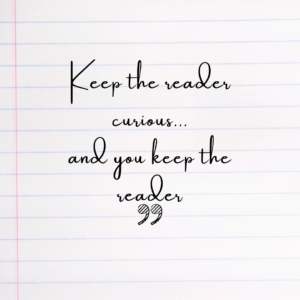
And here’s my new mantra: Keep the reader curious and you keep the reader.
Thanks for following along.
Until next time, have a great week!
~ Gail
Onward!
Before you go, don’t forget to sign up for my mailing list, below